

Google's indexing issue
Lately, we’ve noticed that it can take a long time for Google to index new pages. This applies whether it’s the launch of a new website, new blog posts, or redirects that aren’t being picked up. In this article, we’ve therefore gathered potential reasons why pages are not being indexed, along with practical steps to help speed up the indexing process.
For a page to be searchable in Google, it must be indexed. If the page is not indexed, it will have zero visibility in the organic search results. It is therefore essential to get the page indexed for people to be able to find it.
Need help getting visible online – contact us here!
How can we get our pages indexed faster?
There are many different factors at play, which makes it difficult to be specific about what works and what doesn’t. You have no guarantee that Google will index your pages, but there are actions you can take to increase the chances of getting your pages indexed faster.
When Google crawls your website, Google avoids indexing duplicate content and content it considers unhelpful. It is therefore important to avoid identical content and instead create relevant and unique content that answers the questions your target audience is asking.
Possible reasons why Google is not indexing your pages
- The websites are not optimized for SEO
- Tough competition for the keywords
- Poor/duplicate content
- No other websites link to you
Do you need SEO help?
How to check if the page is indexed?
The best tool to use is Google Search Console – which is Google’s tool for monitoring indexing. Google Search Console reports several statuses for non-indexed pages, such as “Crawled – currently not indexed” or “Discovered – currently not indexed.” While this information does not help resolve the issue directly, it is a good place to start.
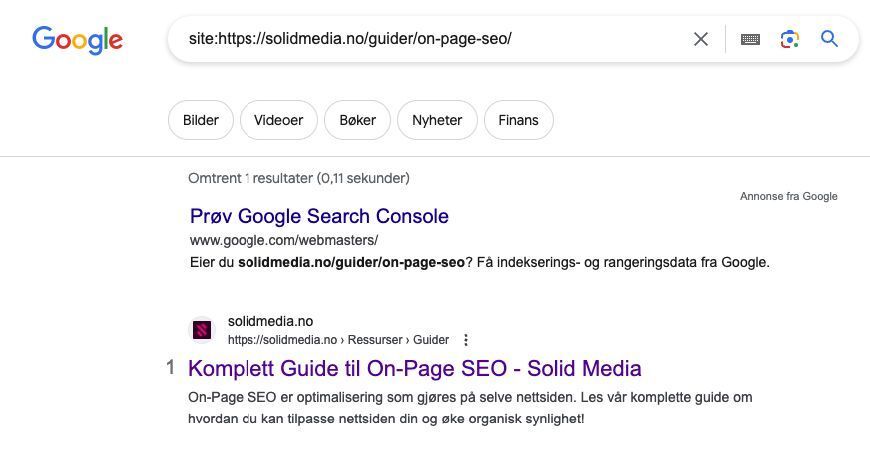
If you haven’t set up Google Search Console for your website, there is another way to quickly check whether a given page is indexed.
Do a Google search where you type “site:(the URL you want to check)”. For example: site:https://www.solidmedia.no/seo/hva-er-on-page-seo
If the exact page you searched for appears in the search results, the website is indexed.
How do we ensure that Google includes the pages?
Google will most likely not visit every single page on your website, regardless of its size. That’s why it’s your responsibility to ensure that Google can discover and index the pages that are critical to your business.
Five things you can do to speed up indexing:
- Use many keywords with high search volume
- Increase content quality and provide concrete answers to questions that have search volume
- Do not duplicate content
- Have a good site structure
- Use both internal and external links
At Solid Media, we have experienced that:
Relevant and unique content helps your site get indexed faster
It is therefore important to conduct a keyword analysis to identify what the target audience is searching for, and a competitor analysis to understand what similar pages are writing about. With insights from these analyses, we will be able to create content that is more accurate and relevant for the target audience.
The combination of low search volume, a small website, and limited content
If you write about something no one is interested in, Google will see that this is not a relevant topic and choose not to prioritize indexing the page. Therefore: High search volume for what you write about can lead to faster indexing. If you write about a topic many people search for and use keywords with high search volume, Google will understand that the content on the page is relevant for the target audience and index the page more quickly.
A solid URL structure with multiple levels and a clear hierarchy
This will make it easier for Google to understand which pages are relevant to each other and increase the chances that Google recognizes their importance
Internal linking gives Google signals that a page is important
When Google sees that there are many links pointing to a page, it considers that page an important part of the website and that it deserves to be indexed. But if a page is isolated and has no links pointing to it, that signals to Google that the page is not important.
Summary
You should now hopefully have a better understanding of why Google can take a long time to index your pages, and what you can do to solve the problem. Indexing issues will of course vary from website to website, but by being aware of how Google indexes pages and what matters to Google, you can better facilitate faster indexing of your site.